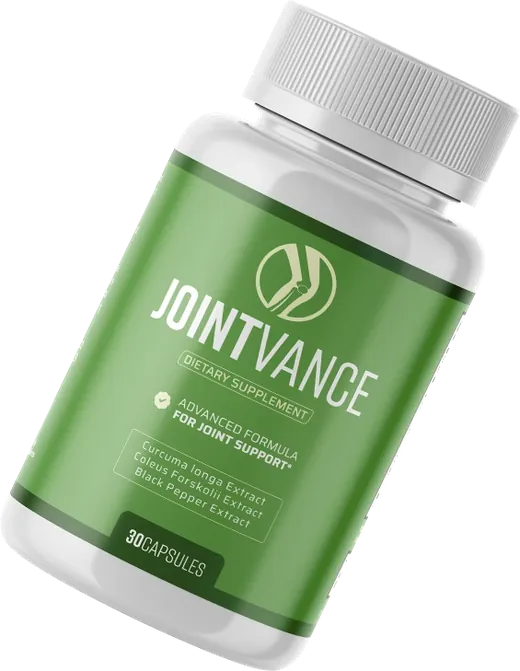
Does JointVance Work? Joint Vance Reviews of the Turmeric Formula
Nobody can say for sure, because no study has tested the JointVance formula. Turmeric eased knee pain a little in short trials, but those trials used about 1,000 mg of curcumin a day and one capsule gives about 28.5 mg. It is not an arthritis treatment. Judge it fairly over 8 to 12 weeks.
Key facts
- The only claim on the label is "Advanced Formula for Joint Support*", with the FDA note. The label does not promise pain relief or new cartilage.
- No trial of the JointVance formula has been published.
- Turmeric knee trials ran 4 to 16 weeks and found a small, short-term drop in pain, with no change in cartilage on MRI.
- Per capsule: about 28.5 mg of known curcuminoids (research: about 1,000 mg of curcumin a day), 5 mg of BioPerine (absorption study: 20 mg), 15 mg of Coleus forskohlii (no joint research).
- Exercise and weight loss, if you carry extra weight, have the strongest evidence for knee and hip osteoarthritis.
- JointVance does not treat arthritis or regrow cartilage.
What does JointVance actually claim to do?
Less than you may have heard. Look at the front of the bottle. It says "Advanced Formula for Joint Support*", and the asterisk points to the FDA note. That is the whole claim. The label does not say it relieves pain, rebuilds cartilage or treats arthritis.
"Joint support" is a general wording, the kind the law allows on a supplement when the FDA note is printed beside it. The FDA does not review these statements before a product is sold (FDA Q&A on Dietary Supplements, 2026). A claim to treat a disease would turn a supplement into a drug. This is why the label stops at "support".
Some sales pages go further. They talk about repair and relief. Those words are not on the bottle, so we do not use them.
How is the JointVance formula meant to work?
Think of it as a plan on paper. Each step comes from research on single ingredients, not from a study of this capsule.
You swallow one capsule
The label says one capsule a day with an 8 oz glass of water. The gelatin shell opens in the stomach.
Turmeric releases curcuminoids
The two turmeric extracts supply the compounds that researchers measure. On their own, they are absorbed poorly.
BioPerine slows the clean-up
Piperine slows enzymes in the gut and liver that clear curcumin, so more can stay in the blood for longer.
Curcumin reaches the body
Researchers study curcumin for its possible effects on inflammation. Larger doses eased knee pain a little in trials.
There is also a fourth ingredient, Coleus forskohlii, at 15 mg. The brand does not explain why it is there, and we found no research linking it to joints.
What does the research on the ingredients say?
JointVance amounts next to the research
| Ingredient | In one capsule | What research used | What it found |
|---|---|---|---|
| Curcuminoids | About 28.5 mg (95% extract) | About 1,000 mg curcumin a day in knee reviews | Less knee pain than placebo, small and short-term |
| Turmeric 4:1 extract | 75 mg, curcumin share not stated | No figure to compare | Unknown contribution |
| BioPerine | 5 mg (printed 5 g) | 20 mg with 2 g curcumin | Raised curcumin absorption in people; not a joint result |
| Coleus forskohlii | 15 mg | 500 mg a day, weight trials | No joint research; weight did not change |
The knee evidence is the part to weigh. A 2016 review of 8 trials found pain about 2 points lower than placebo on a 10-point scale, and the authors called the trials too few and too small for firm conclusions (Daily et al., 2016). A 2021 review of 16 trials with 1,810 adults found better pain and function than placebo, with results similar to common pain pills, but the studies disagreed a lot and ran 16 weeks or less (Wang et al., 2021 (meta-analysis)).
In the 12-week Annals trial, knee pain fell 9.1 points more than placebo on a 100-point scale, and MRI showed no change in swelling or cartilage (Wang et al., 2020 (Annals RCT)).
Why can't turmeric studies be copied onto JointVance?
Because dose and formula both differ. The known curcumin in one capsule is about 3% of the studied amount. The 75 mg 4:1 extract equals about 300 mg of root, but how much curcumin it keeps is not stated, so we never add it to the 28.5 mg figure. Doing so would make the dose look larger than anyone can confirm.
Piperine could raise how much curcumin you absorb. In the 1998 study, 20 mg of piperine with 2 g of curcumin raised blood curcumin by about 2,000% (Shoba et al., 1998). JointVance has a quarter of that piperine, and no one has measured the effect in this capsule.
Do joint supplements work in general?
Searches such as "do joint supplements work" and "are joint supplements effective" get mixed answers, because the group is wide. Here is what the main sources say.
What the major sources say about joint options
| Option | View in the 2019 ACR/Arthritis Foundation guideline | Note |
|---|---|---|
| Exercise | Strongly recommended | For all osteoarthritis |
| Weight loss, if overweight | Strongly recommended | Knee and hip |
| Tai chi, canes, knee braces | Strongly recommended | For the right joint |
| Glucosamine | Strongly recommended against | All joints |
| Chondroitin | Strongly recommended against | Knee and hip |
| Turmeric | Not assessed | Most such products were left out |
A Cochrane review of herbal remedies for osteoarthritis called the benefit of one herbal product small and clinically questionable (Cameron and Chrubasik, Cochrane 2014). The honest summary: supplements have the weakest evidence in this field, and habits have the strongest (ACR/Arthritis Foundation guideline, 2019).
Does JointVance work for arthritis?
JointVance does not treat arthritis. It does not rebuild, repair or regrow cartilage, and no study of any supplement shows that. It is not a replacement for prescribed care or for surgery that your doctor advises.
Most turmeric research is on knee osteoarthritis. Evidence for hips and hands is thinner. See a doctor if a joint is hot, red or badly swollen, if you have pain after a fall, or if pain keeps getting worse.
What would a fair test of JointVance look like?
If you want an answer for your own knees, set up a small test. One change at a time, and notes you can trust.
- Write a baseline on day 1: stairs, morning stiffness and getting up from a chair, each scored from 0 to 10.
- Follow the label: one capsule a day, with an 8 oz glass of water.
- Keep your walking or exercise plan steady, so any change is not due to something new.
- Re-score once a week. Compare numbers, not memory.
- Judge at 8 to 12 weeks, which is two to three bottles. One 30-day bottle is shorter than most trials.
The money-back window is 60 days. That is shorter than the 12-week end of the range, so choose your plan before you start. Stop and call your doctor if you notice unusual tiredness, dark urine or yellow skin or eyes.
Frequently asked questions
Does Joint Vance really work?
No result is promised. Turmeric extracts eased knee pain a little in short trials at much higher curcumin doses, and the JointVance formula has not been tested.
Does JointVance work for arthritis?
It is not an arthritis treatment. The label claim is joint support only, and no study shows that it or any supplement regrows cartilage.
How does JointVance work?
It is meant to work through turmeric, with black pepper extract added to help the body absorb curcumin, plus a small amount of Coleus forskohlii. That is a plan on paper, not a proven result.
Do joint supplements work?
The evidence is mixed and often weak. Guidelines strongly recommend exercise and weight loss, and strongly advise against glucosamine and chondroitin. Turmeric was not assessed.
Do any joint supplements really help?
Turmeric extracts showed a small, short-term drop in knee pain in some trials. Results were modest and the studies were short, so a supplement should sit beside exercise, not replace it.
How long should I try JointVance before deciding?
Turmeric knee trials ran 4 to 16 weeks, so 8 to 12 weeks of daily use is a fair test. Stop if you see no clear change.
Is there a study on the JointVance formula?
No. The page states that no trial has tested the JointVance formula as sold. Research on turmeric knee pain used about 1,000 mg of curcumin a day, while one capsule gives about 28.5 mg of known curcuminoids.
How can I test whether JointVance works for me?
Run a fair test of 8 to 12 weeks, about two to three bottles, and track stairs and stiffness each week. The 60-day money-back window covers part of that time, so note your results before it ends.
What is JointVance used for?
JointVance is a turmeric capsule people take for joint comfort. The label directs one capsule a day with an 8 oz glass of water.
Our view
So, does it work? The straight answer is that we do not know, and neither does anyone else, because the formula has never been studied. What we can say is that the main ingredient has a small, short-term pain signal in research, and that this capsule holds far less of it than the studies used.
If you are curious and healthy, a two-month test beside your usual exercise is a reasonable thing to do. If you want a bigger effect, look first at exercise, weight, a cane or a brace, and talk to your doctor. Check with a pharmacist first if you take blood thinners or prescription medicines. This page is general information, not medical advice.
Plain facts. JointVance is a dietary supplement. It is not FDA approved, and no supplement is. It is not meant to diagnose, treat, cure or prevent any disease, and it does not replace medical care. Bring any medical question to your doctor.
Last updated November 20, 2026
Want to look at the offer yourself?
A fair test needs time and a plan. The order page shows which pack lasts how long and what the guarantee covers.
Gojointvance earns money when you buy through this site. Reading is free.